
Understanding how spalling concrete repair contractors approach their work demystifies a process that many building owners find opaque. The repair of deteriorated concrete is methodical, demanding, and – when executed properly – remarkably effective at extending a building’s service life by decades. Each step in the sequence matters, and skipping any one of them invites premature failure.
The Assessment Phase
Before any physical repair begins, a qualified contractor will conduct a comprehensive structural assessment. This is not a cursory glance at visible damage. It involves systematic investigation to determine the full extent of deterioration, including areas where corrosion is active beneath apparently sound concrete.
The assessment typically includes:
- Visual survey – Documenting all visible cracks, stains, delamination, and exposed reinforcement across affected areas
- Hammer sounding – Tapping concrete surfaces with a hammer to identify hollow areas where debonding has occurred beneath the surface
- Covermeter scanning – Using electromagnetic instruments to map the location and depth of reinforcement bars without breaking the concrete
- Carbonation testing – Applying phenolphthalein indicator to freshly broken concrete to measure how far carbonation has advanced toward the steel
- Half-cell potential testing – Measuring electrical potential on the concrete surface to identify zones where active corrosion is likely
Mr Ng Chee Wai, a senior project manager who has overseen concrete repair works on more than fifty buildings across Singapore, describes the assessment as the foundation of everything that follows. “If you underestimate the extent of the damage at this stage, your repair will fail,” he explains. “We have seen contractors patch only the visible damage and leave corroding steel untreated just centimetres away. Within two years, the adjacent concrete starts spalling.”
Concrete Removal
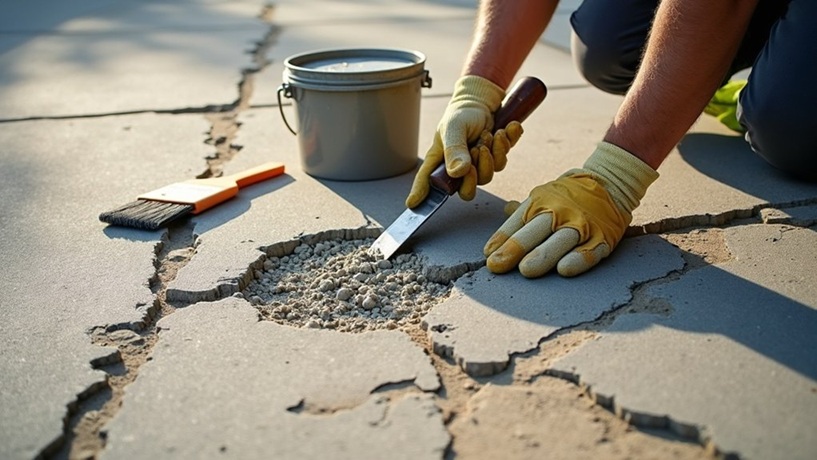
Once the assessment defines the repair boundaries, the damaged concrete must be removed. This is done using pneumatic breakers, chipping hammers, or hydro-demolition equipment, depending on the scale and location of the work. The objective is to remove all carbonated and chloride-contaminated concrete until sound material is reached on all sides of the repair zone.
The removal must extend behind the reinforcement bars to allow proper encapsulation of the steel during the repair. Typically, a minimum clearance of twenty millimetres behind the rebar is required. This step is labour-intensive and generates considerable noise and dust, which is why concrete restoration work in residential buildings often requires careful scheduling and resident notification.
Reinforcement Treatment
With the steel exposed, the contractor can now assess its condition directly. Corroded reinforcement is cleaned using mechanical methods such as wire brushing, needle gunning, or grit blasting until bright metal is visible. If the cross-sectional area of any bar has been reduced by more than a defined threshold – commonly fifteen to twenty per cent – supplementary reinforcement must be added.
After cleaning, the steel receives a protective coating. Options include:
- Cementitious anti-corrosion coatings – Alkaline compounds that restore the passive environment around the steel
- Polymer-modified protective coatings – Providing both corrosion inhibition and improved bond with the repair mortar
- Zinc-rich primers – Offering cathodic protection by sacrificially corroding in place of the steel
The choice of coating depends on the exposure conditions and the repair specification. Structural repair professionals will match the protection system to the specific corrosion mechanism at work.
Repair Mortar Application
The prepared cavity is then filled with a specially formulated repair mortar. These are not ordinary cement mixes. They are engineered to match the thermal expansion coefficient of the existing concrete, minimise shrinkage during curing, and achieve bond strengths that exceed the tensile strength of the parent material.
Application methods vary by repair depth:
- Hand application – For shallow repairs up to approximately fifty millimetres, mortar is applied in layers using a trowel
- Spray application – For larger areas, mortar can be applied by wet-spray methods, which improves compaction and speeds up the process
- Form-and-pour – For deep repairs or overhead work, formwork is erected around the repair zone and a flowable grout is poured in
Each layer must be properly compacted to eliminate voids and allowed adequate curing time before the next layer is applied. Rushing this process creates weak planes within the repair that will crack and debond under service loads.
Surface Protection
A completed patch repair addresses the immediate damage, but without surface protection, the surrounding concrete remains vulnerable to the same deterioration mechanisms. Building facade repair projects therefore typically conclude with the application of a protective coating over the entire treated surface.
Common surface protection systems include:
- Anti-carbonation coatings – Acrylic or silane-based coatings that prevent carbon dioxide from penetrating the concrete while allowing water vapour to escape
- Hydrophobic impregnations – Silane or siloxane treatments that line the pores of the concrete, repelling liquid water while remaining breathable
- Elastomeric coatings – Flexible coatings that bridge hairline cracks and provide both waterproofing and anti-carbonation protection
Quality Control Throughout the Process
Reputable spalling concrete repair contractors implement quality control at every stage. This includes verifying the depth of concrete removal, confirming reinforcement treatment coverage, testing repair mortar compressive strength through cube samples, and conducting pull-off adhesion tests on the finished repairs.
Documentation is essential. A professional contractor will maintain detailed records including photographic evidence of each repair zone before, during, and after treatment. These records form part of the building’s maintenance history and are invaluable for future assessments.
The Outcome of Professional Workmanship
When spalling concrete repair is executed with discipline and technical rigour, the results endure. Well-specified repairs routinely achieve service lives of twenty to thirty years, far exceeding the cost of the initial intervention when measured against the alternative of progressive structural decline.
For building owners and management corporations in Singapore, partnering with competent spalling concrete repair contractors is an investment in both safety and asset preservation – a craft that rewards patience, precision, and professional expertise.