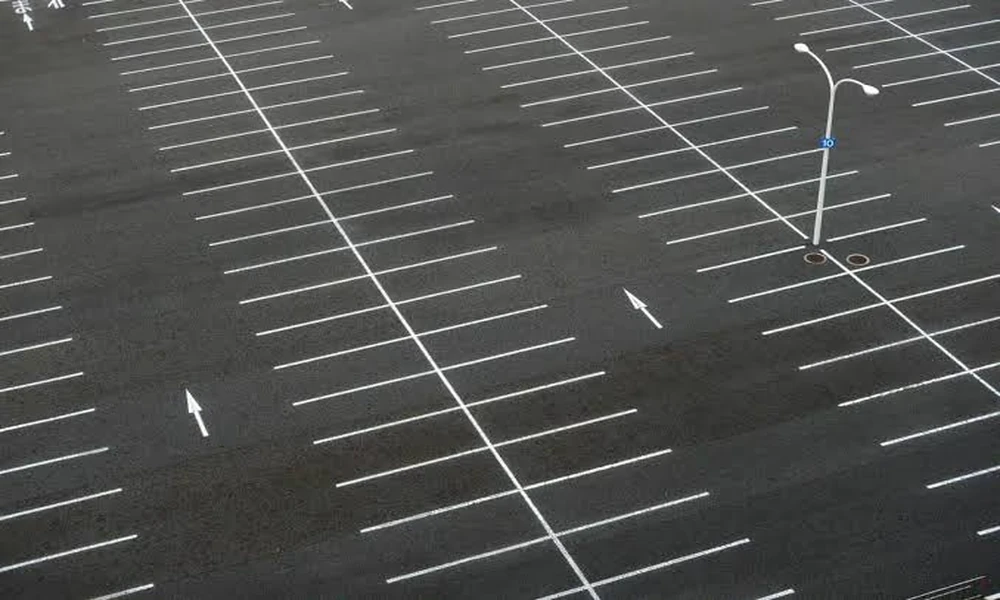

The Assumption Behind Every Empty Parking Space
Most property owners treat parking lot markings as a cosmetic afterthought, something that gets handled once and forgotten for years at a time. The thinking goes that asphalt is durable, paint is cheap, and as long as cars can find a spot, the lines themselves don’t matter much. That assumption holds up fine for the first year or two after a lot is paved and striped. It starts to fall apart the moment weather, traffic volume, and daily wear begin doing what they always do to painted surfaces.
The reality is that a parking lot communicates information constantly, whether anyone is paying attention or not. Drivers rely on lines to judge spacing, direction, and where pedestrian paths begin. When those cues fade or disappear, people stop reading the lot the way it was designed to be read. They guess. They park at odd angles. They clip curbs or crowd neighboring vehicles because the visual guardrails that used to keep behavior predictable are gone. What looks like a minor aesthetic issue is actually a breakdown in a system that was never meant to run on memory alone.
What Commercial Property Data Actually Shows
Property managers who track incident reports and tenant complaints tend to notice a pattern long before they connect it to striping. Fender benders in a lot often cluster near sections where lines have worn thin, not because drivers there are less careful, but because the visual information they need simply isn’t present anymore. ADA-marked spaces that have faded create a different kind of problem, since enforcement becomes murky when the painted boundaries are barely visible. Insurance adjusters who review commercial lot incidents frequently point to poor line visibility as a contributing factor, even when it never shows up as the official cause.
This is where the maintenance conversation shifts from cosmetic to operational. Businesses that schedule regular restriping, rather than waiting until lines are nearly invisible, report fewer complaints about crowded spaces and fewer disputes over who parked where first. Several regional facility teams in Utah have started building parking stall striping for commercial lots into their seasonal maintenance calendar, treating it the same way they treat snow removal contracts or landscaping upkeep. One retail center manager described bringing in parking stall striping for commercial lots after noticing a steady rise in customer complaints about near-misses in the lot, and said the shift in driver behavior was noticeable within weeks of the new lines going down. That kind of feedback loop, where a physical change produces a measurable behavioral change, is hard to dismiss as coincidence.
The pattern holds across property types. Office parks, medical buildings, and mixed-use developments all show the same tendency: when lines are crisp, people park more predictably, and foot traffic through drive lanes decreases because pedestrians stick to marked walkways instead of cutting through rows of parked cars. None of this requires a major renovation or a large capital outlay. It requires attention to a surface most people stop noticing once it’s been there a while.
Turning a Maintenance Line Item Into a Liability Safeguard
Translating this into action starts with an honest walk-through of the property, ideally done at different times of day and in different weather conditions. Lines that look fine on a sunny afternoon can disappear entirely in rain or low light, which is often when accidents are more likely anyway. Property managers who pair this kind of visual audit with a conversation about local code requirements tend to catch problems before they become liability issues, particularly around accessible spaces, fire lanes, and loading zones where compliance isn’t optional.
Budgeting for restriping works best when it’s treated as a recurring cost rather than a reactive one. Lots in regions with heavy snowfall or intense UV exposure wear faster than people expect, and waiting until the lines are gone usually means a larger project than if the work had been scheduled a season earlier. Smart planning also means thinking about layout changes at the same time, since a restriping project is a natural point to reconsider stall width, drive lane direction, or the placement of accessible spaces if the lot has grown more crowded over the years.
The payoff shows up in places that are easy to overlook until something goes wrong. Fewer complaints, fewer minor collisions, and a cleaner compliance record during inspections all trace back to lines that are easy to see and consistently maintained. Tenants and customers rarely comment on good striping directly, but they notice its absence quickly once confusion starts creeping into how they use the lot. Treating this as routine infrastructure, rather than an occasional touch-up, tends to pay for itself well before the next repaving cycle arrives.