
Core Concept
Concrete driveways and patios used to be treated as purely functional surfaces, poured flat and left with a smooth, uniform finish that offered little visual interest. Over the past two decades, homeowners and contractors across Calgary have shifted their expectations, treating concrete less like a slab to be hidden and more like a design element in its own right. This change has been driven by advances in finishing techniques, a better understanding of long-term durability, and a growing appetite for surfaces that hold up to freeze-thaw cycles while still looking intentional. What once got covered with gravel, pavers, or landscaping now often stays exposed, because the concrete itself has become the finished product rather than a base layer waiting to be dressed up. Even modest residential projects now involve a conversation about finish options that simply did not happen a generation ago.
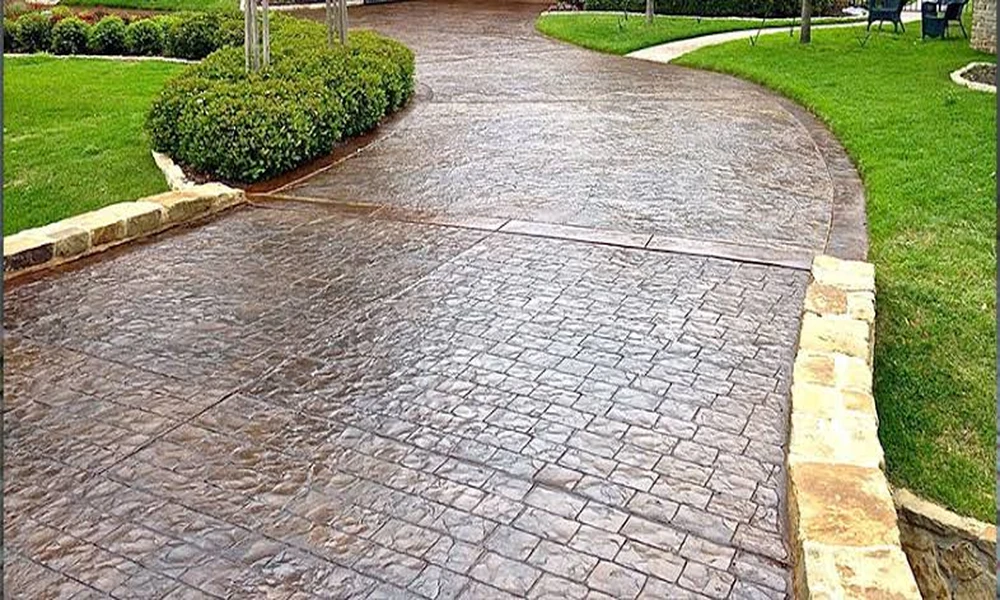
At its core, textured concrete finishing works by removing or manipulating the thin layer of cement paste that naturally rises to the top during placement, allowing the stone, sand, or other aggregate mixed into the concrete to become visible and tactile. Contractors control this by timing the removal of that surface layer carefully, using water, brushes, or light chemical retarders depending on climate and mix design. The result is a surface with more texture and grip than a standard broom finish, along with a speckled, natural appearance that varies with the type of stone used. Because the aggregate itself does the visual work, colour and texture can be adjusted simply by changing the source material, which gives designers a wide palette without altering the underlying concrete formula. Some projects use local river stone for a muted, uniform look, while others bring in imported aggregate for a bolder contrast against the surrounding landscaping.
The Practical Reality
Getting that finish right in practice depends heavily on timing, weather, and the skill of the crew doing the work. Concrete that sits too long before the surface treatment begins can become too hard to expose properly, while concrete treated too early risks dislodging aggregate that has not fully set. Calgary’s temperature swings complicate this further, since a finish that behaves predictably in July can set at a completely different rate in early October. Crews often adjust water content, retarder timing, and even the hour of day they pour to account for these variables. None of this is visible in the finished driveway, but it determines whether that surface looks even and durable five years later or starts showing patchy wear within a single winter.
For homeowners weighing this option against stamped or broom-finished concrete, exposed aggregate concrete finishing tends to come up as the choice that balances appearance with long-term performance, particularly on driveways and pool decks that see heavy foot traffic or vehicle weight. The texture provides slip resistance that smoother finishes lack, which matters on a walkway that ices over in January. It also tends to hide minor surface wear better than a flat finish, since the exposed stone breaks up light in a way that disguises small chips or staining. Contractors who specialize in this technique typically walk clients through aggregate samples before pouring, since the final look depends almost entirely on the stone chosen at that stage. Pricing usually reflects that added labour, since exposing and sealing the aggregate takes more time on site than a standard broom finish.
Material standards matter here too, and contractors who follow Portland Cement Association guidance on mix design, curing times, and surface preparation tend to produce finishes that age more evenly across seasons. Those standards cover details like water-cement ratios and curing temperatures that most homeowners never think about, yet they directly affect whether an exposed aggregate surface stays sound through a decade of freeze-thaw cycles. A finish that looks identical on installation day can perform very differently five winters later depending on whether those underlying steps were followed carefully. Understanding this helps explain why the same finish can vary so much in quality from one contractor to the next, even when the surface aggregate looks nearly identical at first glance. In a climate like Calgary’s, that gap in preparation tends to show up sooner rather than later.
The Evolution of Textured Concrete Surfaces in Calgary